What is a dental implant?
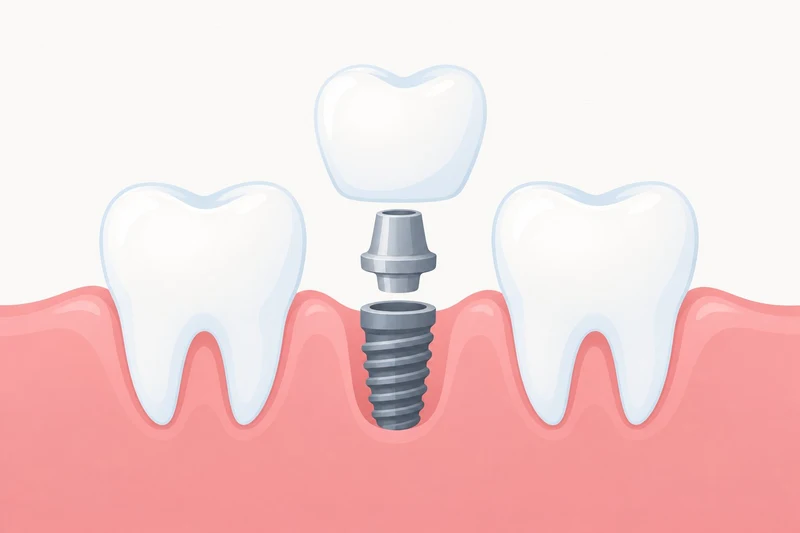
A gap in your smile that you stopped noticing years ago, filled with a tooth that looks and works like the rest. A dental implant is a small post placed in your jawbone to replace a tooth root, with a new tooth built on top.
In plain English
An implant has three parts 1:
- The implant itself, a threaded post, usually titanium (a metal the body accepts), placed in the jawbone. On price lists this is often called "dental implant" or "implant only".
- The abutment, a small connector that screws into the post and sticks up through the gum.
- The crown, the visible tooth-shaped cap that attaches to the abutment. On price lists this is "crown on implant".
Once the post is in, the bone grows around it and locks it in place. Dentists call this osseointegration 2. That is what makes an implant different from a denture or a bridge. It stands on its own.
If several teeth are missing, implants can hold a bridge or a full arch instead of a single crown. See our All-on-4 guide for that.
Who it suits, and who it doesn't
It suits an adult missing one or more teeth who has enough healthy jawbone and clean, healthy gums 1. Your general health matters more than your age, and there is no upper age limit 1,2.
It does not suit people with untreated gum disease, severe bone loss, certain bone disorders or autoimmune diseases, unmanaged diabetes, poor mouth hygiene, or who are currently smoking or vaping 1. Tobacco slows healing, and illnesses such as diabetes or leukemia can interfere with it 2. Thin or short bone does not rule you out. A bone graft can add bone, but it adds months.
How it works, step by step
- Exam and scans. A panoramic X-ray and usually a CBCT scan (a 3D X-ray used to plan implant placement) show how much bone you have and where the nerves and sinuses sit 3,4.
- Extraction, if the tooth is still there. Most people are back to normal activities within 48 to 72 hours, though the bone takes several weeks to heal 5.
- Bone graft, only if needed. Powdered bone material is packed into the thin spot. The graft needs at least three months to knit, and full healing can take up to a year 6. For the upper back jaw, a sinus lift adds bone under the sinus; healing after a sinus graft is about six to eight months 7.
- Implant surgery. Placing the post takes about 15 to 20 minutes 8. The first round of healing takes about a week 1.
- Fusing. The bone grows around the post. Cleveland Clinic gives three to nine months 1, and about three months on its implant service page 8. The ADA says it can take several months 2. You may get a temporary tooth in the meantime 2.
- Abutment and crown. The clinic uncovers the post, fits the abutment, takes impressions and fits the crown. This visit takes about an hour 1.
Cleveland Clinic says the whole process can take six to 12 months 8. Sources do not give a number of trips. The crown cannot go on until the bone has fused, so plan on the crown being a second trip. A graft first can add a trip before that. The clinic will tell you after an exam and X-rays.
What the price usually includes, and what can cost extra
Quotes are often split into "implant" and "crown on implant". Ask whether these are in or out:
- X-rays and the CBCT scan
- Extraction of the old tooth
- Bone graft or sinus lift
- The abutment (some clinics price it separately from the implant and the crown)
- A temporary tooth while you heal
- The final crown, and which material (zirconia, porcelain fused to metal, or e.max)
- Sedation
- Follow-up visits and adjustments
- Your second trip
What it costs
Single implant with crown: what it costs by city
| City | Price | vs US | Clinics |
|---|---|---|---|
| United States typical | $3,000-$5,000 | ||
| Medellín Colombia | $1,350 | 55-73% less | 4 |
| Tijuana Mexico | $1,900 | 37-62% less | 13 |
| Mexico City Mexico | $2,467 | 18-51% less | 4 |
Questions to ask a clinic before you book
- What exactly is in the quote? Is the abutment included? Is the crown?
- Which implant brand do you use, and can I have the brand and lot number in writing?
- What will the crown be made of, and why that material for this tooth?
- Do I need a bone graft or sinus lift? What does my scan show?
- How many trips, and how many days each?
- Is there a written warranty? What does it cover, what does it exclude?
- Who fixes problems after I go home, and who pays for that?
- Can I take my X-rays, scan and records home?
What can go wrong, and how to lower the risk
An implant can fail to fuse. Signs to watch for are a loose implant, bleeding gums, fever, pus or swelling 1. Surgery can bring infection, nerve damage, injury to the mouth or a hole in the sinus lining 9. A bone graft carries risks of infection, nerve damage and heavy bleeding 6. With a sinus lift, a tear in the sinus membrane is the most common problem 7.
Later on, the main threat is peri-implantitis, a gum infection around the implant that destroys bone. Reported rates range from 10% to more than 40%, depending on how it was measured. Risk factors include past gum disease, smoking, uncontrolled diabetes, poor cleaning and leftover cement under the crown 10.
With good care, implants can often last a lifetime; crowns and bridges on them last about 15 years 1.
To lower the risk, stop smoking, control diabetes, get gum disease treated first, clean around the implant every day, and keep your check-ups 1,10.
Words you'll hear
- Abutment: the connector between the post and the crown.
- Osseointegration: bone growing around the post.
- Bone graft: bone material added where the jaw is too thin.
- Sinus lift: bone added under the sinus in the upper back jaw.
- CBCT scan: the 3D X-ray used to plan implants.
- Peri-implantitis: infection around an implant that causes bone loss.
Your own dentist, and the clinic's dentist after a scan, decide whether an implant fits you.
Sources
- Cleveland Clinic, "Dental Implants: Types, Purpose & Benefits". https://my.clevelandclinic.org/health/treatments/10903-dental-implants
- American Dental Association, MouthHealthy, "Implants". https://www.mouthhealthy.org/all-topics-a-z/implants
- Cleveland Clinic, "Dental X-rays: Purpose & Types". https://my.clevelandclinic.org/health/diagnostics/11199-dental-x-rays
- U.S. Food and Drug Administration, "Dental Cone-beam Computed Tomography". https://www.fda.gov/radiation-emitting-products/medical-x-ray-imaging/dental-cone-beam-computed-tomography
- Cleveland Clinic, "Tooth Extraction: Surgery & Healing". https://my.clevelandclinic.org/health/treatments/22120-tooth-extraction
- Cleveland Clinic, "Dental Bone Graft: Process, Purpose & Healing". https://my.clevelandclinic.org/health/treatments/21727-dental-bone-graft
- Alsharekh et al., "Evolving Techniques and Trends in Maxillary Sinus Lift Procedures in Implant Dentistry: A Review of Contemporary Advances", Cureus, 2024. https://pmc.ncbi.nlm.nih.gov/articles/PMC11560410/
- Cleveland Clinic, "Get Dental Implants". https://my.clevelandclinic.org/services/dental-implants
- Cleveland Clinic, "Implant Supported Dentures: Process, Benefits & Care". https://my.clevelandclinic.org/health/treatments/24303-implant-supported-dentures
- Javiya P et al., "Peri-implantitis: Etiology, prevention and management strategies", Bioinformation, 2025. https://pmc.ncbi.nlm.nih.gov/articles/PMC12697511/