What is a dental crown?
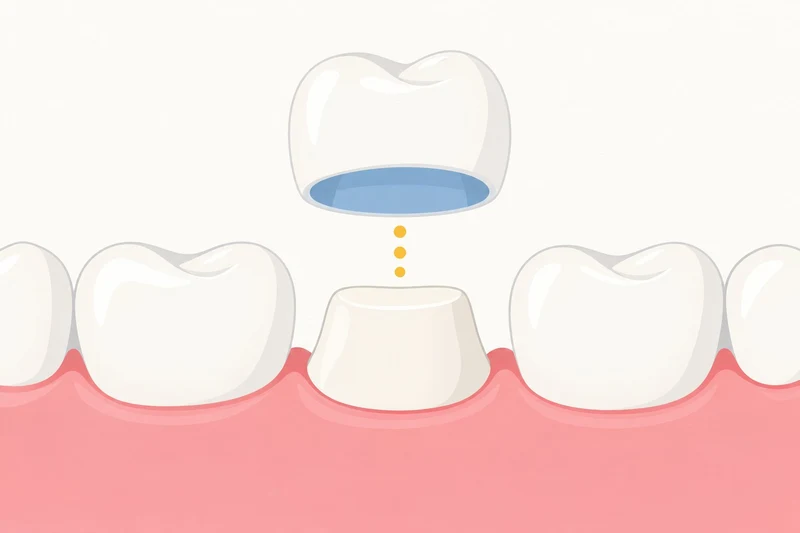
Chewing on both sides again, and a front tooth that finally matches its neighbors. A dental crown is a tooth-shaped cap that covers a damaged tooth, or sits on top of an implant, to make it strong and whole again.
In plain English
A crown covers the whole visible part of a tooth. Cleveland Clinic describes it as "a tooth-shaped cap that restores a decayed, broken, weak or worn-down tooth" 1. It is used when a tooth is cracked, worn, badly stained, has had a root canal, or does not have enough left to hold a filling 1,2. Crowns also anchor bridges and sit on top of dental implants 1,2.
The materials you will see on price lists 1:
- Zirconia. A hard white ceramic. Cleveland Clinic calls it "extremely durable" and able to take heavier chewing forces.
- Porcelain, or all-ceramic. Looks most like natural enamel of any crown type.
- e.max. A brand name for a glass ceramic called lithium disilicate 3. Also a type of all-ceramic crown.
- PFM, porcelain fused to metal. A metal shell with porcelain on top. Strong, but the porcelain can chip and show the metal underneath over time.
- Metal, such as gold. Rarely chips and lasts longest, but looks like metal.
- Resin. Cheaper and weaker, used mostly as a temporary crown, lasting three to five years on average.
"Crown on implant" is the same cap, but attached to an abutment on an implant instead of cemented over a tooth. See our dental implant guide.
Who it suits, and who it doesn't
A crown suits a tooth that is still worth saving but too weak or damaged for a filling: a large old filling, a crack, heavy wear, or a tooth that has just had a root canal 1,2. It is also the standard finish on an implant.
It does not suit a tooth that cannot be saved. If the root is cracked or the gum disease around it is advanced, the dentist may recommend removing the tooth instead. Crowns also involve grinding the tooth down, which cannot be undone 1. If you grind or clench your teeth, tell the dentist; you may need a night guard to protect the crown 1.
How it works, step by step
The traditional method takes two visits 1:
- First visit. The dentist numbs the tooth, shapes it down to make room for the cap, takes an impression or digital scan, and fits a temporary crown.
- The wait. A lab makes the crown, usually two to three weeks, sometimes longer 1.
- Second visit. The temporary comes off, the dentist checks the fit and color, and cements the final crown.
Some clinics have a milling machine on site (called CAD/CAM or same-day crowns) and can shape, make and fit the crown in one visit 1.
For a crown on an implant, the crown goes on after the implant has fused to the bone, which takes months. See the implant guide.
For a trip abroad, the two-visit method fits one trip if the lab turnaround is short. Ask the clinic how many days you need to stay between the first and second visit. If the crown follows a root canal or an implant, that changes the timeline, so ask.
What the price usually includes, and what can cost extra
Ask whether these are in or out of the crown price:
- X-rays
- The exam and any cleaning
- The temporary crown
- A root canal, if the tooth needs one first
- A post and core (a small peg and filling built inside a weak tooth to hold the crown)
- The crown material. Zirconia, e.max, PFM and porcelain are usually priced differently
- Adjustments after fitting
- For crown on implant: the abutment
What it costs
Zirconia crown: what it costs by city
| City | Price | vs US | Clinics |
|---|---|---|---|
| United States typical | $1,400 | ||
| Nogales Mexico | $400 | 71% less | 5 |
| Puerto Vallarta Mexico | $416 | 70% less | 5 |
| San José Costa Rica | $450 | 68% less | 6 |
| Cancún Mexico | $450 | 68% less | 21 |
| Los Algodones Mexico | $450 | 68% less | 27 |
| Playa del Carmen Mexico | $450 | 68% less | 5 |
| Medellín Colombia | $500 | 64% less | 7 |
| Ciudad Juárez Mexico | $500 | 64% less | 3 |
| Tijuana Mexico | $500 | 64% less | 30 |
| Mexico City Mexico | $697 | 50% less | 4 |
Questions to ask a clinic before you book
- What material do you recommend for this tooth, and why?
- Is the temporary crown in the price?
- Do you make crowns on site, or send them to a lab? How many days between visits?
- Does this tooth need a root canal or a post first, and is that quoted?
- Is there a written warranty on the crown? What does it exclude, such as grinding damage?
- Who fixes a chipped or loose crown after I go home, and who pays?
- Can I take my X-rays and records home?
- Will you check the bite so the crown does not hit first when I close?
What can go wrong, and how to lower the risk
Cleveland Clinic lists the risks. The tooth has to be ground down, which cannot be reversed. Teeth can be sensitive to heat and cold after fitting. The crown can crack or chip. Bacteria can get trapped under a poorly fitted crown. Allergic reactions to the material are rare but happen 1.
A review of 13 studies found five-year survival of 96.6% for lithium disilicate (e.max) crowns, 96% for zirconia, and more than 95% for metal-ceramic crowns 3. The usual problems were chipping, fracture, a gap at the edge, discoloration at the margin, and decay under the crown 3.
Crowns last five to 15 years on average, and some last upwards of 30 with good care 1.
To lower the risk, brush twice a day with fluoride toothpaste, floss daily, avoid very hard or sticky foods, wear a mouth guard if you grind, and keep regular cleanings 1.
Words you'll hear
- Zirconia: a hard white ceramic used for crowns and bridges.
- e.max: a brand of glass ceramic (lithium disilicate) used for crowns and veneers.
- PFM: porcelain fused to metal.
- Abutment: the connector a crown on implant sits on.
- Temporary teeth: the placeholder crown you wear while the lab makes the final one.
Your own dentist, and the clinic's dentist after an exam, decide whether a crown fits and which material.
Sources
- Cleveland Clinic, "Dental Crowns: Types, Procedure & Care". https://my.clevelandclinic.org/health/treatments/10923-dental-crowns
- American Dental Association, MouthHealthy, "Crowns". https://www.mouthhealthy.org/all-topics-a-z/crowns
- Aswal GS et al., "Clinical Outcomes of CAD/CAM (Lithium disilicate and Zirconia) Based and Conventional Full Crowns and Fixed Partial Dentures: A Systematic Review and Meta-Analysis", Cureus, 2023. https://pmc.ncbi.nlm.nih.gov/articles/PMC10199723/