What are veneers?
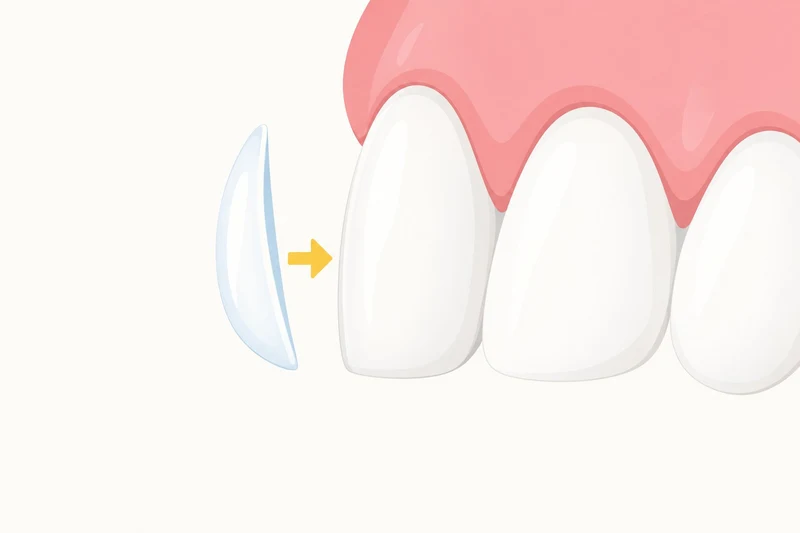
Smiling in the family photo with your teeth showing, instead of the closed-lip version. A veneer is a thin shell bonded to the front of a tooth to cover chips, stains, small gaps or uneven edges.
In plain English
A veneer covers only the front face of a tooth, not the whole tooth like a crown does 1. Cleveland Clinic describes veneers as "custom-made shells that fit over the front surfaces of your teeth" 2. Dentists use them for teeth that are chipped, stained, slightly crooked or gappy 1.
Two main types:
- Porcelain veneers. Made in a lab from ceramic, then bonded on. The ADA calls them "strong, long-lasting and natural-looking" and says they "tend to be the more expensive option" 1.
- Composite veneers. Built directly on the tooth from tooth-colored filling material. They may need less enamel removed and fewer visits, but they are "not as stain- or wear-resistant" 1.
You may also see "no-prep" veneers, which remove less enamel than usual but still some 2.
Enamel is the hard outer layer of the tooth. To fit most veneers, the dentist shaves a thin layer of it off. That step cannot be undone, so the ADA and Cleveland Clinic both say the treatment is not reversible 1,2.
Who it suits, and who it doesn't
It suits someone who wants to change how healthy front teeth look and has no big untreated dental problems 2.
It does not suit people with untreated cavities or gum disease; those come first 2. The ADA says veneers may not be a good choice if you clench or grind your teeth or have a deep overbite 1. Veneers are cosmetic, so most insurance does not cover them 1,2.
How it works, step by step
Porcelain, two visits 2:
- First visit. The dentist examines the teeth, removes a thin layer of enamel, takes impressions, and may fit temporary veneers while the lab works 1,2.
- The wait. The lab makes the veneers, typically several weeks 2.
- Second visit. The dentist checks fit, shape and color, bonds each veneer with dental cement, and adjusts your bite 2.
Composite can often be done in one visit, shaped straight onto the tooth 1.
There is no downtime. You go back to normal the same day 2.
For a trip abroad, ask the clinic how many days sit between the first and second visit for porcelain. Some clinics have an on-site lab and turn them around faster. The clinic will tell you after an exam.
What the price usually includes, and what can cost extra
Veneers are priced per tooth. Ask whether these are in or out:
- The exam and X-rays
- A cleaning or whitening of the neighboring teeth so the shade matches
- Temporary veneers between visits
- The material, porcelain or composite, and for porcelain, which ceramic
- Fixing cavities or gum problems first
- A night guard if you grind
- Adjustments after bonding
- Repairs or re-bonding if one comes off
What it costs
Porcelain veneer: what it costs by city
| City | Price | vs US | Clinics |
|---|---|---|---|
| United States typical | $900-$2,500 | ||
| Bucaramanga Colombia | $300 | 67-88% less | 5 |
| Medellín Colombia | $345 | 62-86% less | 7 |
| Cali Colombia | $400 | 56-84% less | 7 |
| Nogales Mexico | $400 | 56-84% less | 3 |
| San José Costa Rica | $450 | 50-82% less | 4 |
| Cancún Mexico | $450 | 50-82% less | 16 |
| Los Algodones Mexico | $450 | 50-82% less | 27 |
| Playa del Carmen Mexico | $450 | 50-82% less | 5 |
| Tijuana Mexico | $500 | 44-80% less | 25 |
| Cartagena Colombia | $618 | 31-75% less | 7 |
| Mexico City Mexico | $674 | 25-73% less | 8 |
Questions to ask a clinic before you book
- Porcelain or composite for my teeth, and why?
- How much enamel will you remove, and can you show me on a model or scan?
- How many days between the first and second visit?
- Which ceramic and which lab do you use?
- Is there a written warranty? Does it cover chips, or a veneer coming off?
- Who re-bonds a veneer if it comes off after I go home, and who pays?
- Will you check for cavities and gum disease first?
- Can I take my records and photos home?
What can go wrong, and how to lower the risk
You lose some enamel for good, and most veneers cannot be reversed 1,2. Teeth may become more sensitive to heat and cold 2. A veneer can chip, crack, wear down or come loose over time and need repair or replacement 1.
For porcelain, a review of 25 studies found a 10-year survival of 95.5%. Fracture was the most common problem, then debonding (coming off), and both happened mostly in the first years after fitting 3.
For composite, a two-year trial of 120 veneers found no significant difference in survival between composite (93.4%) and ceramic (95%), but the composite ones stained and got rough far more often 4.
Cleveland Clinic gives 10 to 15 years with good care 2.
To lower the risk, brush twice a day with a soft brush, floss daily, do not use your teeth as tools, avoid very hard foods, limit dark drinks that stain, and wear a night guard if you grind 1,2.
Words you'll hear
- Veneer: a thin shell bonded to the front of a tooth.
- Composite: tooth-colored filling material, used for the cheaper veneer type.
- e.max: a brand of glass ceramic often used for porcelain veneers.
- Temporary teeth: the placeholders you wear between visits.
Your own dentist, and the clinic's dentist after an exam, decide whether veneers fit you and which type.
Sources
- American Dental Association, MouthHealthy, "Veneers". https://www.mouthhealthy.org/all-topics-a-z/veneers
- Cleveland Clinic, "Veneers: What Are Dental Veneers? Cost, Procedure & Advantages". https://my.clevelandclinic.org/health/treatments/23522-dental-veneers
- Alenezi A et al., "Long-Term Survival and Complication Rates of Porcelain Laminate Veneers in Clinical Studies: A Systematic Review", Journal of Clinical Medicine, 2021. https://pmc.ncbi.nlm.nih.gov/articles/PMC7961608/
- Elkaffas et al., "Randomized Clinical Trial on Direct Composite and Indirect Ceramic Laminate Veneers in Multiple Diastema Closure Cases: Two-Year Follow-Up", Materials, 2024. https://pmc.ncbi.nlm.nih.gov/articles/PMC11278355/