What is a root canal?
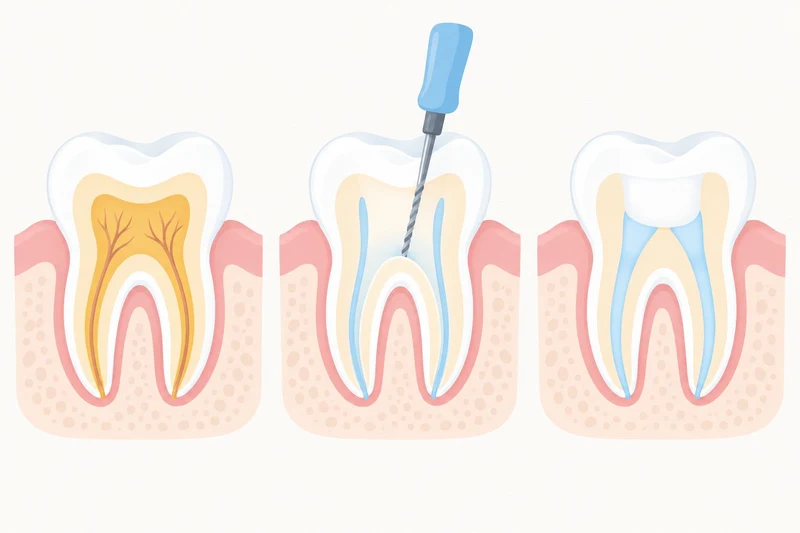
Sleeping through the night without a throbbing tooth, and keeping the tooth. A root canal cleans out an infection from inside a tooth and seals it so the tooth can stay.
In plain English
Inside every tooth is soft tissue called the pulp, which holds the nerve and blood vessels 1. When bacteria reach it, through a deep cavity, a crack, an injury or repeated dental work, it gets infected and hurts 1,2. Left alone, the infection can form an abscess, a pocket of pus, inside the tooth or in the bone around the root 1.
A root canal is the fix that keeps the tooth. The dentist removes the infected pulp, cleans and shapes the hollow canals inside the roots, fills them with a rubber-like material, and seals the tooth 1,2. The ADA puts it plainly: "Root canals are used to repair and save your tooth instead of removing it" 1.
The other option is pulling the tooth and replacing it with an implant or bridge 2.
Who it suits, and who it doesn't
It suits a tooth with infected or dying pulp that still has enough sound structure to rebuild. Signs include pain when chewing or touching the tooth, a swollen jaw or tender gums, a pimple on the gum that oozes pus, a tooth that darkens or loosens, or pain spreading to the jaw or nearby teeth 2.
It does not suit a tooth that is too broken down or cracked through the root to rebuild. In that case the dentist may recommend extraction and a replacement 2. Only an X-ray and exam can tell which.
How it works, step by step
- X-ray and numbing. The dentist takes an X-ray, numbs the tooth, and puts a small rubber sheet (a dental dam) around it to keep it dry 1,2.
- Opening. A small hole is made in the top of the tooth 2.
- Cleaning. The infected pulp is removed with tiny tools, and the canals are cleaned, shaped and disinfected 2,3.
- Filling. The canals are filled with a rubber-like material called gutta-percha, and the opening gets a temporary filling 2.
- Final restoration. On a later visit, the temporary filling is replaced with a regular filling or, more often, a crown to protect the tooth 1,2. The NHS says a crown may be needed if the tooth was badly infected 3.
Cleveland Clinic says most root canals take about 60 to 90 minutes and some need more than one visit 2. The ADA says one or two office visits 1. The NHS says usually two or more appointments of one to two hours 3. Most people recover in less than a week 2.
Abroad, the root canal and the crown are often done on the same trip, since a crown needs two visits a couple of weeks apart. Ask the clinic how many days it needs.
What the price usually includes, and what can cost extra
A "root canal" price often covers only the inside work. Ask whether these are extra:
- X-rays before and after
- The number of canals. Back teeth have more roots, so many clinics charge more for molars
- A post and core (a peg built inside the tooth) if little tooth is left
- The final crown, which is nearly always a separate item
- Retreatment, if an old root canal has failed
- Antibiotics or pain medicine
- A specialist (an endodontist) instead of a general dentist
What it costs
Root canal: what it costs by city
| City | Price | vs US | Clinics |
|---|---|---|---|
| United States typical | $900-$1,500 | ||
| Nogales Mexico | $315 | 65-79% less | 6 |
| San José Costa Rica | $350 | 61-77% less | 3 |
| Cancún Mexico | $350 | 61-77% less | 12 |
| Los Algodones Mexico | $350 | 61-77% less | 17 |
| Los Cabos Mexico | $350 | 61-77% less | 3 |
| Playa del Carmen Mexico | $350 | 61-77% less | 6 |
| Tijuana Mexico | $350 | 61-77% less | 32 |
| Mexico City Mexico | $490 | 46-67% less | 6 |
Questions to ask a clinic before you book
- Does the price include the crown? If not, what does the crown cost?
- How many canals does this tooth have, and does the price change with that?
- Will a general dentist or a root canal specialist do it?
- How many visits, and how many days do I need to stay?
- Is there a written warranty, and what does it cover if the infection comes back?
- Who treats me if it flares up after I go home, and who pays?
- Can I take my X-rays home, including the one taken after the filling?
- Do you use a dental dam?
What can go wrong, and how to lower the risk
Your tooth and the area around it may feel sensitive for a few days 1. If the treatment does not clear the infection, the dentist may redo the root canal, or remove the tooth and replace it with an implant or bridge 2. The crown is there to protect the tooth afterwards, so do not skip it 1,2.
Cleveland Clinic says most root canals are successful and can last for many years, often a lifetime 2. The ADA says the same with proper care 1.
To lower the risk, get the crown on soon after the root canal, brush with fluoride toothpaste, floss, avoid chewing hard things on that tooth until it is crowned, and keep your check-ups 1,3.
Words you'll hear
- Root canal: the hollow inside a tooth root, and the treatment that cleans it.
- Crown: the cap that protects the tooth afterwards.
- Extraction: pulling the tooth, the alternative if it cannot be saved.
- Temporary teeth: the temporary filling or crown between visits.
Your own dentist, and the clinic's dentist after an X-ray, decide whether a root canal can save the tooth.
Sources
- American Dental Association, MouthHealthy, "Root Canals". https://www.mouthhealthy.org/all-topics-a-z/root-canals
- Cleveland Clinic, "Root Canal: Procedure & Recovery". https://my.clevelandclinic.org/health/treatments/21759-root-canal
- NHS, "Root canal treatment". https://www.nhs.uk/conditions/root-canal-treatment/