What is All-on-6?
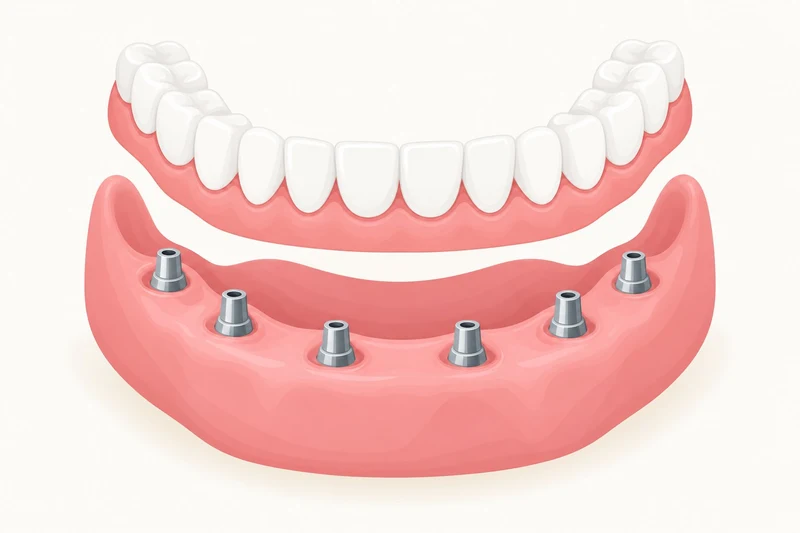
Biting into an apple without thinking about it first. All-on-6 is a full row of fixed teeth for one jaw, held by six dental implants.
In plain English
A dental implant is a small post, usually titanium (a metal the body accepts), that a surgeon places in your jawbone to work like a tooth root 1. All-on-6 uses six of those posts to hold one bridge, a single piece carrying a full row of teeth, for the whole upper or lower jaw. That full row is called an arch.
In the arrangement described in a 2026 clinical study, two implants go at the front of the jaw and four go further back 2. All-on-4 uses two at the front and two tilted at the back 2,3. The extra two implants are the whole difference. The bridge, the surgery and the healing are otherwise the same idea.
Like All-on-4, the bridge is screwed on and stays in 4, and many clinics fit temporary teeth on the day of surgery, which dentists call immediate loading 3.
Who it suits, and who it doesn't
Clinics do not pick four or six by preference. In the largest comparison we found, 943 patients, the clinic chose the number of implants using a decision system based on the height and width of the jawbone, plus risk factors such as smoking and other health conditions 5. So All-on-6 tends to be offered where the bone, the jaw, or the patient's risk profile calls for more support. The clinic's scan decides this, not the brochure.
Beyond that, the same rules apply as for any implant. It does not suit people with untreated gum disease, unmanaged diabetes, or who currently smoke or vape 1. Your general health matters more than your age 6.
How it works, step by step
- Exam and scans. A panoramic X-ray (one wide image of the whole mouth) and usually a CBCT scan, a 3D X-ray used to plan implant positions 7,8.
- Extractions. Any remaining teeth in that jaw come out, either in the same surgery or months earlier with a healing gap 4.
- Surgery. Six implants are placed. If the scan shows too little bone in the upper back jaw, a sinus lift may be needed first. Healing after a sinus graft is about six to eight months 9.
- Temporary teeth. With immediate loading, a temporary bridge goes on the same day or soon after 3,5.
- Healing. The implants fuse to the bone (osseointegration). Cleveland Clinic gives three to six months, sometimes longer 4.
- Final bridge. Impressions are taken and the final bridge is made and fitted.
Sources do not give a number of trips. The final bridge waits for the implants to fuse, so plan on the final teeth being a second trip. If you need a sinus lift or bone graft first, that can add a trip before surgery. The clinic will tell you after an exam and X-rays.
What the price usually includes, and what can cost extra
Six implants means two more posts and two more sets of parts, so expect the quote to differ from All-on-4 at the same clinic. Ask what is inside it:
- CBCT scan and X-rays
- Extractions
- Bone graft or sinus lift, if needed
- Sedation
- The temporary bridge
- The final bridge, and whether it is acrylic or zirconia (a hard white ceramic)
- A night guard if you grind
- Follow-up visits, adjustments and repairs
- Your second trip: flights, hotel and time off
What it costs
All-on-6, one arch: what it costs by city
| City | Price | vs US | Clinics |
|---|---|---|---|
| Mexico City Mexico | $7,565 | 6 | |
| Medellín Colombia | $10,000 | 7 | |
| Ciudad Juárez Mexico | $10,780 | 5 | |
| Los Algodones Mexico | $11,155 | 24 | |
| Cancún Mexico | $11,700 | 12 | |
| Playa del Carmen Mexico | $12,800 | 3 | |
| Tijuana Mexico | $12,800 | 25 | |
| San José Costa Rica | $14,495 | 4 |
Questions to ask a clinic before you book
- Why six implants for me rather than four? What did my scan show?
- What exactly is in the quote, and what is not?
- Which implant brand do you use, and can I have that in writing?
- What is the final bridge made of, and what does each material cost?
- How many trips, and how many days each?
- Is there a written warranty? What does it cover, what does it exclude, and what do I have to do to keep it valid?
- Who fixes problems after I go home, and who pays?
- Can I take my scans, X-rays and records home with me?
- If one implant fails, what happens to the bridge, and what does the fix cost?
What can go wrong, and how to lower the risk
Sources disagree on whether six implants do better than four. In the 943-patient comparison, survival was almost identical: 98.4% for four-implant and 98.7% for six-implant bridges at five years 5. A separate 200-patient study over 12 months found lower stress on the bone, less bone loss and higher implant stability with six 2. One is long-term and large, the other is short-term. Neither settles it.
The general implant risks apply. An implant can fail to fuse. The bridge can chip or break, more often in acrylic and in people who grind 3. Peri-implantitis, a gum infection around an implant that destroys bone, is reported in 10% to more than 40% of cases depending on how it is measured; smoking, past gum disease, uncontrolled diabetes and poor cleaning raise the risk 10. Surgery can bring infection, nerve damage, injury to the mouth or a hole in the sinus lining 4. If you have a sinus lift, a tear in the sinus membrane is the most common complication 9.
To lower the risk, stop smoking, control diabetes, treat gum disease first, clean around every implant daily, keep maintenance visits, and wear a night guard if you grind 1,10.
Words you'll hear
- All-on-X: the family name for full-arch bridges on any number of implants.
- Sinus lift: bone added under the sinus so upper back implants have something to hold.
- Osseointegration: bone growing around the implant.
- Zirconia: the hard white ceramic used for many final bridges.
- Peri-implantitis: infection around an implant that causes bone loss.
Your own dentist, and the clinic's dentist after a scan, decide whether four, six or something else fits your jaw.
Sources
- Cleveland Clinic, "Dental Implants: Types, Purpose & Benefits". https://my.clevelandclinic.org/health/treatments/10903-dental-implants
- Sriharsha et al., "A comparative clinical study of stress distribution around implant supporting all-on-four versus all-on-six prosthetic concepts", Bioinformation, 2026. https://pmc.ncbi.nlm.nih.gov/articles/PMC13150235/
- Gaonkar SH et al., "Survival rates of axial and tilted implants in the rehabilitation of edentulous jaws using the All-on-four concept: A systematic review", Journal of the Indian Prosthodontic Society, 2021. https://pmc.ncbi.nlm.nih.gov/articles/PMC8061444/
- Cleveland Clinic, "Implant Supported Dentures: Process, Benefits & Care". https://my.clevelandclinic.org/health/treatments/24303-implant-supported-dentures
- Caramês J et al., "Four vs. Six Implant Full-Arch Restorations: A Direct Comparative Retrospective Analysis in a Large Controlled Treatment Cohort", Journal of Clinical Medicine, 2025. https://pmc.ncbi.nlm.nih.gov/articles/PMC12194759/
- American Dental Association, MouthHealthy, "Implants". https://www.mouthhealthy.org/all-topics-a-z/implants
- Cleveland Clinic, "Dental X-rays: Purpose & Types". https://my.clevelandclinic.org/health/diagnostics/11199-dental-x-rays
- U.S. Food and Drug Administration, "Dental Cone-beam Computed Tomography". https://www.fda.gov/radiation-emitting-products/medical-x-ray-imaging/dental-cone-beam-computed-tomography
- Alsharekh et al., "Evolving Techniques and Trends in Maxillary Sinus Lift Procedures in Implant Dentistry: A Review of Contemporary Advances", Cureus, 2024. https://pmc.ncbi.nlm.nih.gov/articles/PMC11560410/
- Javiya P et al., "Peri-implantitis: Etiology, prevention and management strategies", Bioinformation, 2025. https://pmc.ncbi.nlm.nih.gov/articles/PMC12697511/